Better work design creates healthier conditions for people and performance.
Thoughtful leadership helps manage pressure, clarity, and accountability.
Strong systems help teams perform consistently without unnecessary strain.
Many contemporary approaches to performance and well-being place responsibility primarily on individuals: manage stress better, build resilience, adapt faster, and recover quicker. While individual capability matters, this framing overlooks a critical reality.
Mindful Management shifts attention from individual coping to organizational responsibility, asking how leadership behaviors and system design either support or undermine sustainable execution.


Mindful Management is grounded in the belief that performance challenges are rarely the result of individual failure. More often, they emerge from how work is designed, governed, and sustained within organizations operating under constant pressure.
This approach treats mental health, cognitive load, and human sustainability as integral elements of execution, not peripheral concerns to be addressed only when problems surface.
Rather than focusing on motivation or personal resilience alone, Mindful Management examines the systems that shape behavior, decision-making, and strain over time.
Within Mindful Management, mental health is understood as an organizational and delivery risk, similar in nature to schedule compression, resource constraints, or unclear governance. Unmanaged strain, persistent ambiguity, and chronic overload do not simply affect morale, they:
Treating these conditions as risks allows organizations to address them proactively, rather than reacting after performance deteriorates.


Leadership plays a central role in shaping how pressure is created, absorbed, or amplified.
This is not about reducing expectations. It is about aligning demands with structure, so performance can be sustained without constant depletion.
A recurring theme within the approach is the role of clarity.
When clarity is absent, individuals compensate through overwork, guesswork, and risk avoidance, all of which increase strain while reducing effectiveness.Mindful Management treats clarity not as a communication task, but as a design requirement.
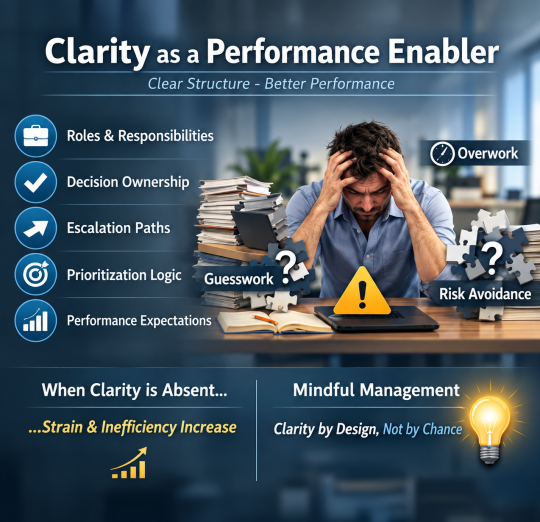
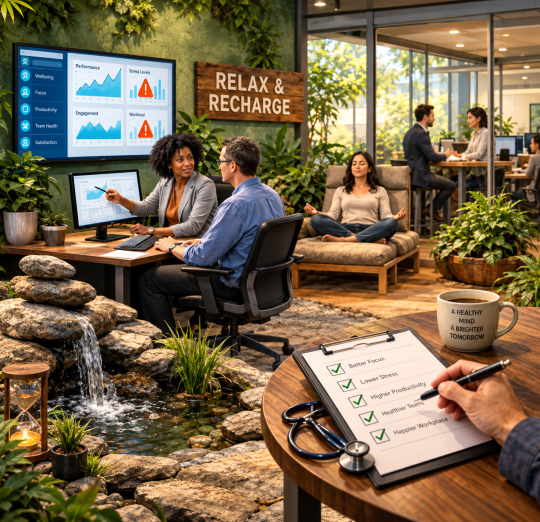
Sustainable performance is not achieved through endurance, heroics, or continuous acceleration. It is achieved when systems are intentionally designed to:
This perspective recognizes that long-term performance depends on how work is structured, not just on how hard people try.
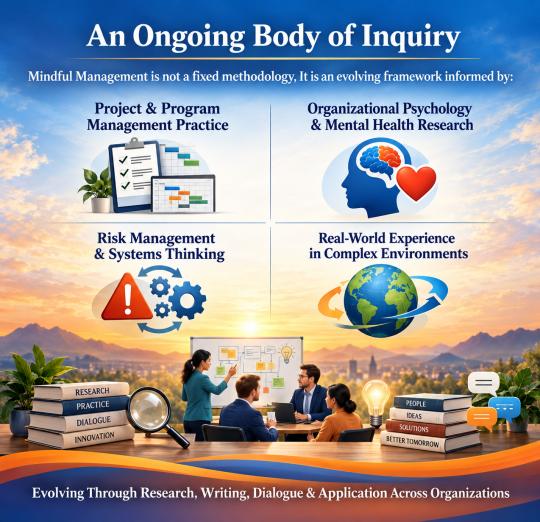
Mindful Management is not a fixed methodology. It is an evolving framework informed by:
The work continues to develop through research, writing, dialogue, and application across different organizational contexts.

This approach informs:
In each case, the intent remains the same: to help organizations see more clearly how work is designed, and what that design makes possible or impossible over time.
Pressure is part of complex work. The difference lies in how organizations respond to it. Explore a more intentional way to shape leadership, clarity, and performance.

Mindful Management exists to help organizations think more clearly about how work is designed, and what it costs when it isn’t.
Every organization faces pressure and complexity. Let’s explore what’s creating that pressure and where meaningful change can begin.
Thoughtful, practical support designed to help organizations understand pressure, strengthen leadership, and create more sustainable ways of working. Our approach is tailored to your context, grounded in research, and focused on meaningful, lasting outcomes.
We look beyond individual performance to understand the systems, structures, and leadership practices that shape pressure, decision-making, and execution.
Our approach connects research with real-world organizational and project environments, providing thoughtful perspectives that can be applied to complex workplace challenges.
There is no one-size-fits-all solution. Our work adapts to your organization’s maturity, challenges, priorities, and readiness for change.